Every parent driving with a rear-facing baby faces the same problem: the car seat that keeps your baby safest also makes it impossible to see them with a quick glance. Two products solve that problem in very different ways: a baby car mirror, which reflects your baby's image back to you through the rearview mirror, and a baby car camera monitor, which streams live video from a camera near the car seat to a small screen up front. Both get you a view of your baby without turning around. Here's how they actually compare.
How Each One Works
Baby Car Mirror
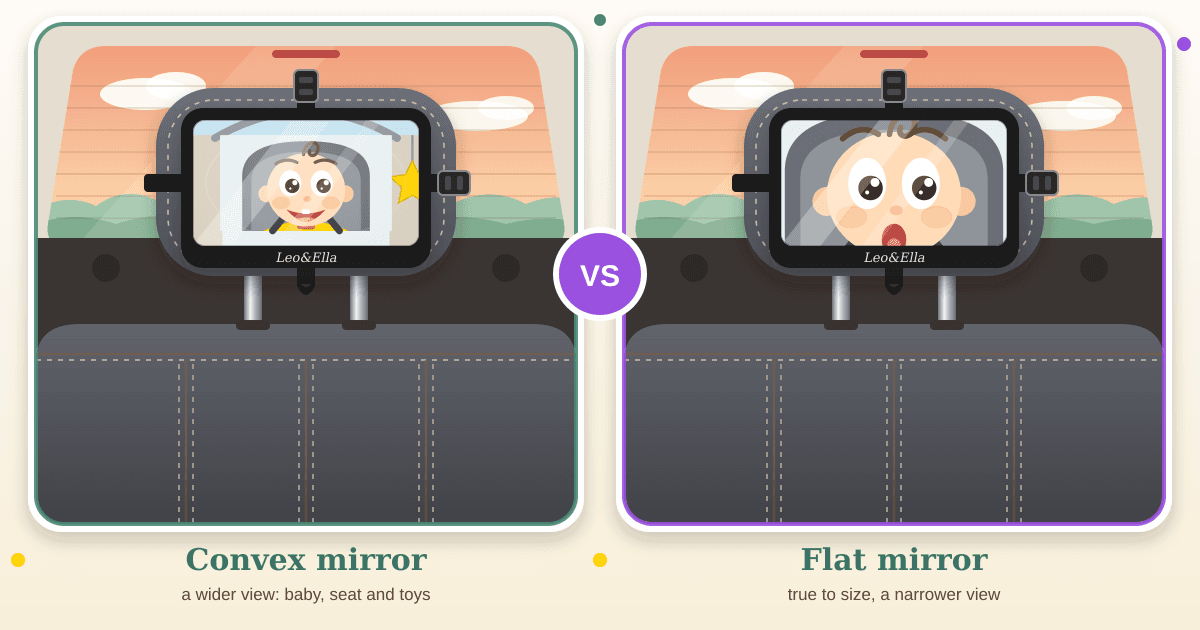
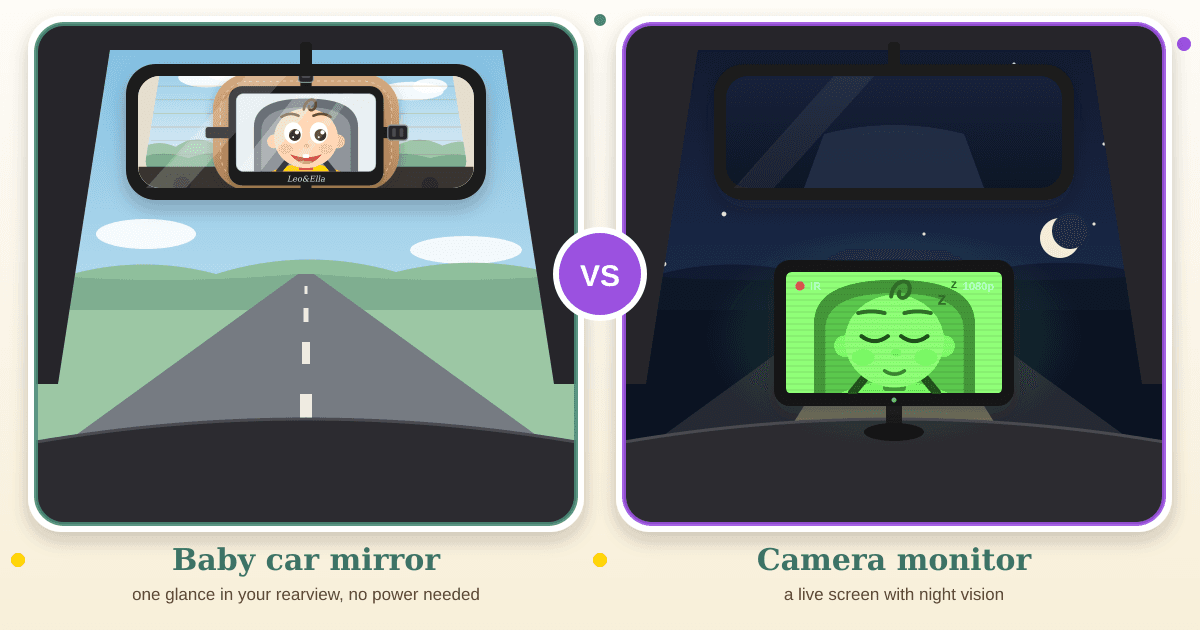
A baby car mirror is a passive optical device: a convex or flat mirror surface, mounted on a strap around the rear headrest, angled so it reflects your baby's face into your rearview mirror. There's nothing to power, pair, or charge. You install it once, adjust the angle, and it works for as long as the strap stays in place.
Baby Car Camera Monitor
A camera monitor is an active electronic system: a small camera clips near the car seat and streams a live video feed, usually over a wired connection, to a dashboard-mounted screen. Because it's a real camera and screen rather than a reflection, it can include features a mirror can't, like night vision, digital zoom, and a picture that doesn't depend on ambient light bouncing correctly off your baby's face.
Where a Mirror Has the Edge
- Nothing to power or fail electronically. A mirror has no battery, no cable, and no screen that can freeze or lose signal. It works the same on day one and year three.
- No glowing screen at night. A dashboard-mounted monitor adds a lit screen to your peripheral vision after dark, which some drivers find more distracting than a quick glance at a mirror.
- Simple installation. Strap it to the headrest, adjust the angle, done. There's no wiring to route through the cabin or a 12V outlet to give up.
- Lower cost. A mirror is a one-time purchase with no ongoing power draw, and it's typically the cheaper of the two products.
Where a Camera Monitor Has the Edge
- Works in the dark. A mirror needs some light reflecting off your baby to show anything useful; on an overcast evening drive or in a dim back seat, the reflection can wash out. A camera with night vision, like the infrared LEDs on Leo&Ella's Camio camera monitor, keeps showing a clear picture after dark.
- A closer, steadier picture. A camera lens held a few inches from your baby's face, feeding a dedicated screen, generally shows more detail than a small reflected image glimpsed inside your rearview mirror.
- Works from any seating position. A camera can be mounted to frame a baby seated off to one side, in a middle seat, or in a car without a usable headrest strap point, without needing to also line up with your own line of sight to the rearview mirror.
- One screen, multiple angles. Camera systems with a rotating or repositionable camera let you adjust the view without pulling over to re-strap a mirror.
What About Distraction?
Both products are designed to reduce distraction compared to the alternative, which is turning around in your seat, but they do it differently. A mirror piggybacks on a glance you're already taking, since your eyes pass over the rearview mirror constantly while driving. A dashboard monitor is a second screen that draws your eyes to a new location, so it's worth mounting it low and close to your normal sightline, and treating it the way you'd treat a backup camera display: a quick check, not something to watch while driving.
Can You Use Both?
Yes, and plenty of parents do. A mirror gives you the instant, glanceable check you use on every trip, while a camera monitor covers the situations a mirror struggles with, like night drives or a car seat position that doesn't line up cleanly with the rearview mirror. Since a mirror needs no power and a wired camera monitor is a more involved install, many parents start with a mirror and add a camera monitor later if they find themselves wanting a clearer view in low light.
Which One Should You Get?
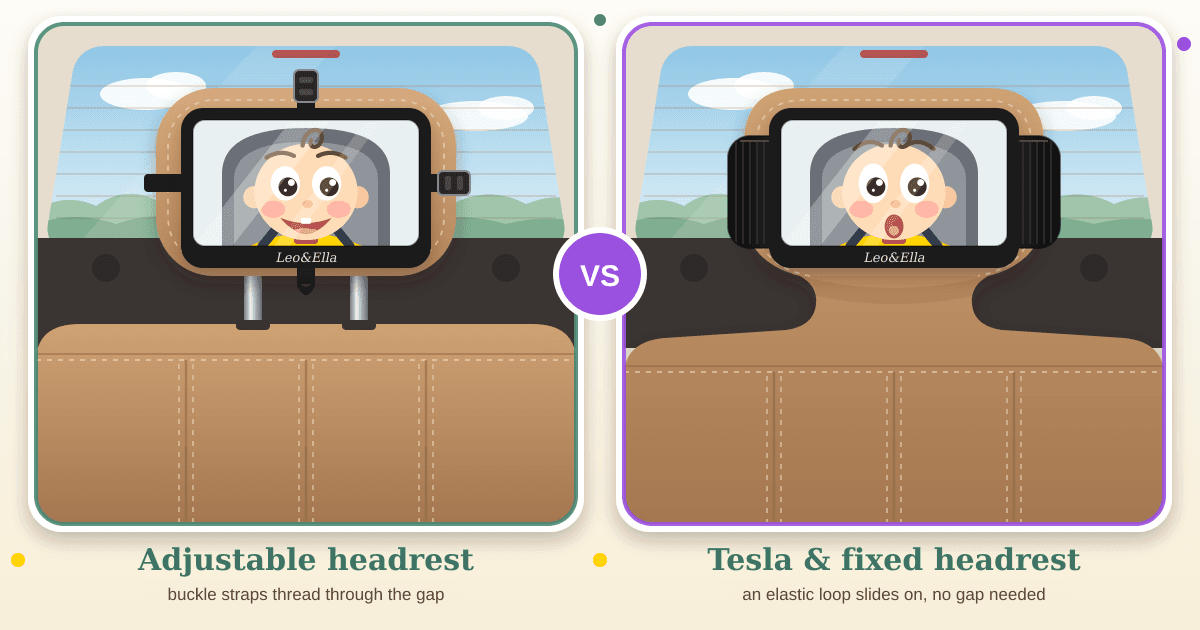
- Daytime commuter, simple setup: A mirror covers the need with the least hardware and the lowest cost. Leo&Ella's Adjustable baby car mirror fits most headrests, and the Tesla and fixed-headrest mirror is built for cars without a strap-friendly headrest.
- Frequent night driving or a dim back seat: A camera monitor's night vision does what a mirror physically can't, since a mirror needs light to reflect.
- Baby seated off-center or in a car with tricky headrests: A camera can be mounted and aimed independently of your own sightline, which gives more flexibility than a mirror that has to line up with the rearview mirror.
- Want the most complete view possible: Run both. The mirror handles the everyday glance, and the camera monitor is there for the trips where you want a closer, clearer look.
Final Thoughts
Neither product is strictly better; they solve the same problem with different trade-offs between simplicity and capability. A baby car mirror is the lower-cost, install-it-once option that works well for most daytime driving. A baby car camera monitor adds night vision and a closer picture at the cost of a wired install and a screen to glance at. Whichever you choose, the goal is the same: a fast, reliable way to check on your baby without taking your attention off the road for long.