Keeping an eye on your rear-facing baby while driving shouldn't feel like a balancing act. A well-installed car mirror gives you a quick, reassuring glance at your little one through the rearview mirror, without turning around or losing focus on the road. This guide walks you through how to install a baby car mirror, adjust it for a clear view, and set yourself up so the mirror helps rather than distracts.
What You Need Before You Start
Most baby car mirrors come with adjustable straps that attach to the rear headrest. The two most common mounting styles are buckle straps and continuous loop straps. Before you begin, make sure you have:
- Your baby car mirror and its included straps or mounting hardware
- Access to the rear seat where your baby's car seat is installed
- A few minutes to adjust and test the view while parked
That's it. No tools are required for either strap type, and the whole process typically takes under five minutes — often under 60 seconds with a continuous loop design.
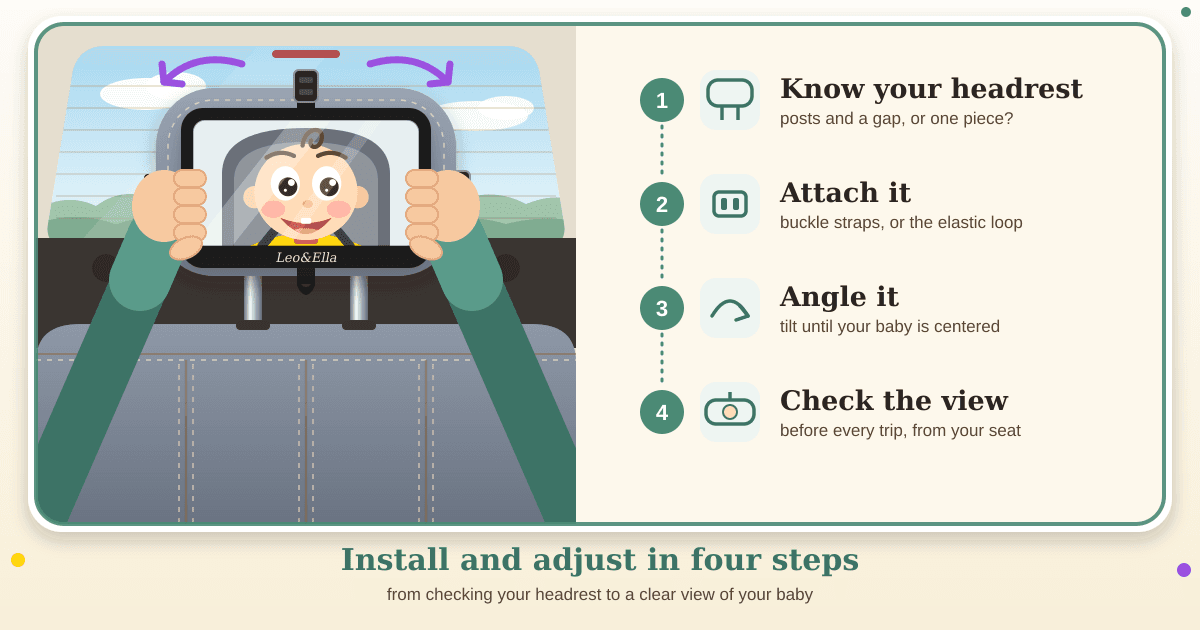
Step 1: Identify Your Headrest Type
The rear headrest is where most baby car mirrors attach, but not all headrests are the same. Understanding yours helps you get a secure fit from the start.
Adjustable Headrests
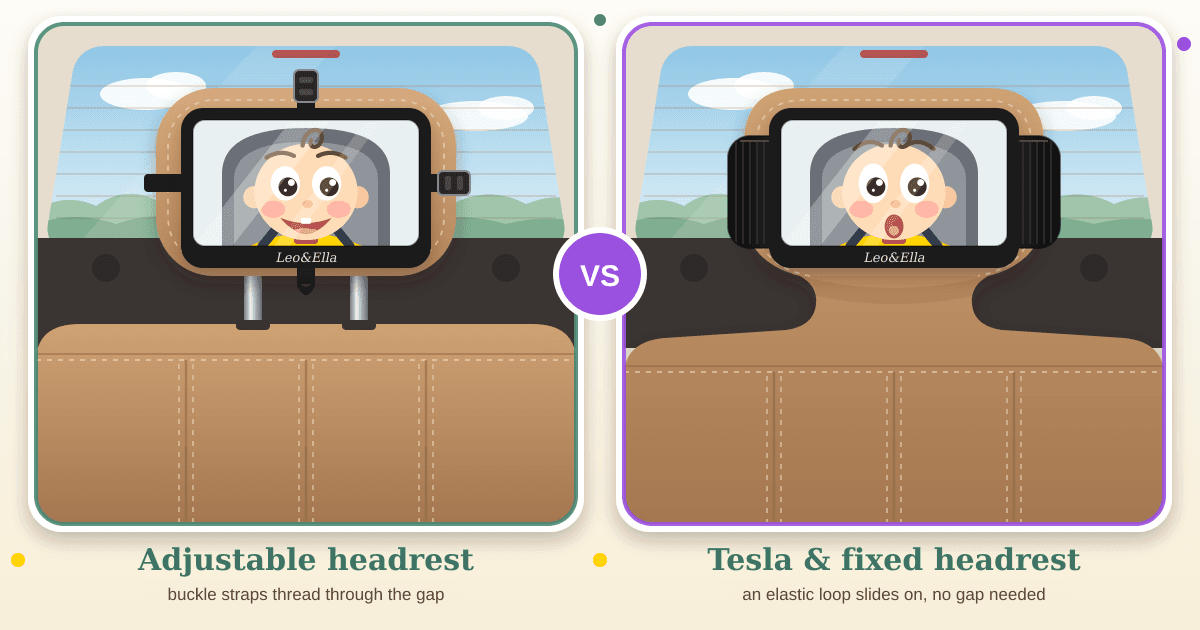
These are the most common type in modern vehicles. The headrest slides up and down on two metal posts. To install your mirror, raise the headrest slightly to create a gap between it and the top of the seat back. Thread the mirror's straps through this gap and around the back of the headrest, then pull the headrest back down to lock the straps in place. This creates a tight, stable mount.
Fixed or Integrated Headrests (Tesla, Volvo, and Others)
Vehicles like the Tesla Model 3, Model Y, Model S, and Model X, along with many Volvo and BMW models, have headrests that are molded directly into the seat and cannot be raised or removed. These fixed headrests are one of the most common reasons parents struggle with traditional buckle-strap mirrors, since there is no gap to thread a strap through.
If your mirror uses a continuous loop strap — a single stretchy band that wraps all the way around the headrest — fixed headrests are no problem. Simply stretch the loop over the top of the headrest and pull it down until the mirror sits flush against the back of the seat. The elastic tension keeps it firmly in place without needing a gap or posts to anchor to. The Leo&Ella Tesla baby car mirror uses this continuous loop system and is specifically designed for fixed headrests.
If your mirror uses a buckle strap instead, wrap the straps around the widest part of the headrest and tighten them firmly. If the straps don't grip well on the smooth surface, check whether your mirror includes a non-slip pad or consider placing a thin rubber grip between the strap and the seat fabric for extra hold. Note that buckle straps tend to be less secure on fixed headrests compared to continuous loop designs.
No Headrest at All
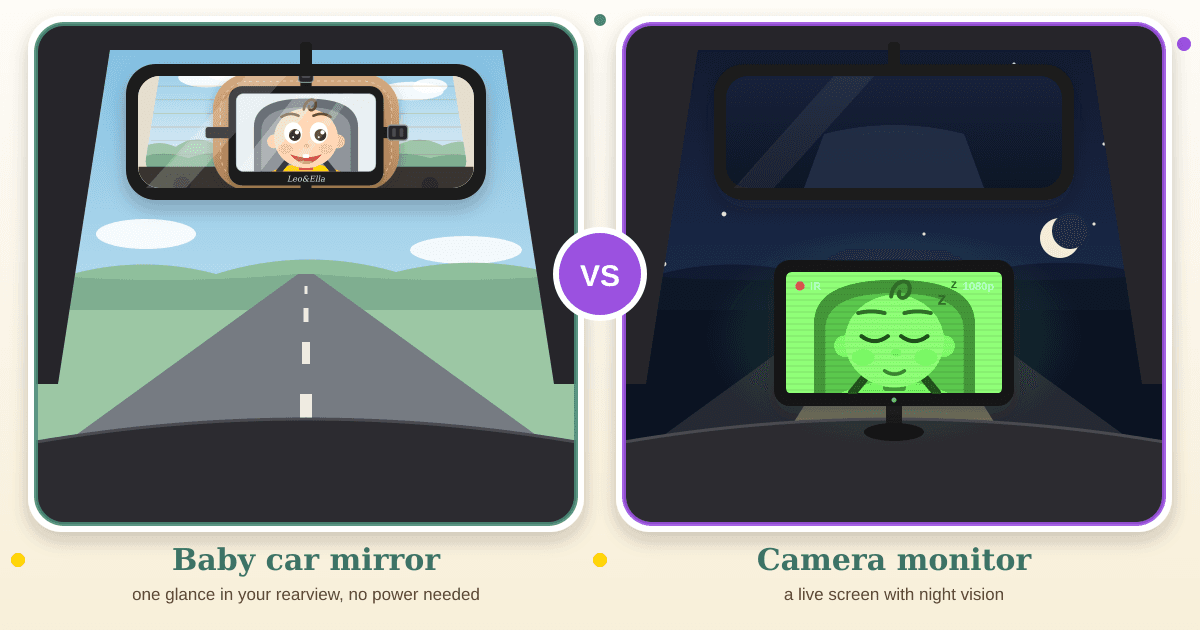
If the rear seat position you're using has no headrest, you may be able to attach the mirror to an adjacent headrest and angle it toward your baby. Alternatively, some parents find that a camera-based monitor works better for this setup, since it doesn't depend on headrest placement at all.
Step 2: Attach the Mirror Securely
Once you know your headrest type, follow the steps that match your mirror's strap style.
Continuous Loop Strap (Stretch-Fit)
Mirrors with a continuous loop use a single elastic band that forms a complete circle. This is the simplest mounting method and works especially well on fixed headrests found in Tesla, Volvo, and similar vehicles.
- Hold the mirror against the back of the headrest, with the reflective surface facing your baby's car seat.
- Stretch the loop over the top of the headrest and pull it down behind the seat. The elastic tension should draw the mirror snugly against the headrest.
- Adjust the strap position so it sits flat against the headrest with no twists or bunching. The strap should wrap evenly around the headrest for maximum grip.
- Give it a firm tug to confirm the mirror won't shift during a sudden stop. The continuous loop should hold the mirror flush with no wobble.
Buckle or Hook-and-Loop Strap
Traditional mirrors use one or two straps with a buckle or Velcro closure. These work best on adjustable headrests where you can thread the strap through the gap.
- Position the mirror on the seat back, facing toward your baby's car seat. The reflective surface should point at your child's face.
- Loop the straps around the headrest (or through the gap beneath it) and fasten the buckle or press the Velcro closure.
- Pull the straps tight. The mirror should sit flush against the seat back with no wobble. Give it a firm tug to confirm it won't shift during a sudden stop.
- Lower the headrest (if adjustable) to clamp down on the straps for added security.
Whichever strap type you use, a mirror that moves around on the seat is one that will need constant re-adjusting, so take an extra moment here to get it snug.
Step 3: Angle the Mirror Toward Your Baby
With the mirror mounted, the next step is setting the angle so your baby's face is clearly visible in your rearview mirror.
- Sit in the driver's seat in your normal driving position.
- Look at your rearview mirror. You should be able to see the baby car mirror reflected in it.
- Have a partner tilt and rotate the baby mirror until your child's face is centered in the reflection. If you're alone, make small adjustments, return to the driver's seat to check, and repeat until the view is right.
- Lock the angle. Many mirrors have a ball joint or pivot that can be tightened once you find the right position. Make sure it's firm enough that road vibrations won't shift it.
The goal is a view that requires only a brief glance at your rearview mirror, not a head turn, to confirm your baby is comfortable.
Step 4: Check the View Before Every Trip
Mirrors can shift slightly over time, especially after loading and unloading the car seat. Build a quick check into your routine:
- Before you start the engine, glance at your rearview mirror to confirm you can see your baby's face clearly.
- If the angle has shifted, adjust it while parked. It only takes a few seconds.
- Check that the straps are still tight and the mirror is stable.
This small habit keeps the mirror useful and avoids the temptation to fiddle with it while driving.
Center-Seat Positioning
Many parents place the car seat in the center of the rear bench for added side-impact protection. If the center position has its own headrest, installation is the same as described above. If it doesn't, you have a couple of options:
- Use an adjacent headrest. Mount the mirror on the headrest behind the passenger seat (or driver's side) and angle it toward the center. This works well with mirrors that have a wide pivot range.
- Consider a wide-angle mirror. A larger, convex mirror can capture more of the rear seat area, making it easier to see a baby who isn't directly behind the mirror's mounting point.
Reducing Distraction While Driving
A baby car mirror is a safety tool, but only if it's used in a way that keeps your eyes on the road. Here are a few practical guidelines:
- Make all adjustments before you drive. Never try to reposition the mirror while the vehicle is moving. If it shifts mid-trip, pull over safely before touching it.
- Limit your glances. Treat the baby mirror the same way you treat your side mirrors: a quick look, not a prolonged stare. A one-to-two-second glance is enough to confirm your baby is okay.
- Trust what you hear. If your baby is fussing, you'll hear it. You don't need to visually confirm every sound. Save your glances for moments when you genuinely need reassurance.
- Keep the mirror clean. A smudged or foggy mirror forces you to squint and look longer. A quick wipe before the trip keeps the view crisp.
Choosing a Mirror That Fits Your Setup
Not every mirror works perfectly in every vehicle. When selecting one, think about your specific situation:
- Headrest compatibility: If you drive a Tesla or another vehicle with fixed headrests, look for a mirror with a continuous loop strap designed specifically for that setup. The Leo&Ella Tesla baby car mirror uses a continuous loop system that wraps securely around any headrest type, including the fixed headrests in Tesla Model 3, Y, S, and X. For adjustable headrests, a buckle-strap mirror like the Leo&Ella baby car mirror also works well and stays secure over time.
- Mirror clarity: Look for a shatter-proof, distortion-free mirror surface. Acrylic mirrors are lighter and safer than glass in the event of an impact.
- Pivot range: A full-rotation ball joint or 360-degree swivel gives you more flexibility to find the right angle, especially for center-seat or off-center mounting.
- Camera alternatives: If your vehicle layout makes mirror placement difficult, or if you prefer not to have an object mounted to the headrest, a camera-based baby monitor is worth considering. Some families find it suits their vehicle and viewing preferences better.
Common Installation Mistakes to Avoid
- Loose straps: A mirror that wobbles will vibrate out of position on rough roads. Always tighten until there's no play. With continuous loop straps, make sure the elastic sits flat and isn't twisted.
- Using a buckle strap on a fixed headrest: Buckle straps are designed to thread through a gap between the headrest and the seat. On fixed headrests (common in Teslas), they often can't get a secure grip. If you have fixed headrests, choose a mirror with a continuous loop strap instead.
- Mounting too high or too low: The mirror should be roughly level with your baby's face. If it's angled too steeply, you'll get a view of the ceiling or the seat cushion instead.
- Skipping the driver's seat check: The view from the back seat doesn't tell you what you'll actually see while driving. Always confirm the angle from behind the wheel.
- Adjusting while driving: This is the most important one. If the mirror needs repositioning, pull over. A few seconds of delay is always worth it.
Final Thoughts
Installing a baby car mirror is one of the simpler car seat accessories to set up, and when done right, it gives you calm reassurance on every drive. The key is a secure mount, a properly angled reflection, and the discipline to make adjustments only while parked. Take five minutes before your next trip to get it right, and you'll have a clear view of your little one without adding stress to your drive.